Wednesday, 4 January 2017

CLASSROOM PORTRAITS BOOK AVAILABLE


Just a heads up, for those of you still looking for an affordable copy, the Prestel edition of Classroom Portraits seems to be available from at least one Amazon seller for £40 at the moment.

Wednesday, 28 September 2016

CHILDHOODS - SIDE GALLERY


Side Gallery, 5-9 Side, Newcastle upon Tyne, NE1 3JE, UK
Saturday 1st October - Sunday 27th November, 2016. 
Tuesday-Saturday 11- 5

Delighted to be part of the exhibition that is relaunching the Side Gallery after its redevelopment. The show includes a selection of the Classroom Portraits alongside work by 11 other photographers and film makers, all of which reflects upon childhood in one way or another. It's great that the Side have classic material such as Wendy Ewald's wonderful Portraits and Dreams and Chris Killip's Seacoal in their collection as well as lesser known gems such as Tish Murtha's Juvenile Jazz Bands. The show also features recently completed or ongoing projects (that I have yet to see) by the likes of Kai Wiedenhoefer and Liz Hingley.


Thursday, 8 October 2015

THE FUTURE IS OURS - TOWNER ART GALLERY


The first British showing of the global Classroom Portraits series opens tomorrow evening at Towner Gallery, Eastbourne. For opening times and information please see here.

The show features some 60 framed pieces while smaller scale work and research material is displayed in vitrines. Also included are a series of Classroom Portrait videos as well as newly commissioned video portraits of individual pupils.

I will be giving an illustrated talk about this and other projects on Saturday 10th at 2 pm


Friday, 2 October 2015

HIDDEN PRESENCE, CARDIFF.

Sugar Factory Road, St Kitts, 2015. © Julian Germain
Customs House, Bute Street, Cardiff.
October 1- 31. Open Tues - Sat 11-5

In 2014 Julian Germain was commissioned to respond to the life story of Nathaniel Wells (1779 - 1852) who was born into slavery on the island of St Kitts in the Caribbean, the illegitimate child of a slave woman and sugar plantation owner. Extraordinarily, at the age of 9, Nathaniel was sent to Britain to be educated and he subsequently inherited his father’s fortune, along with the sugar plantations and slaves, including his own mother. In 1802, at the age of only 23 and a ‘black’ man of African descent, he purchased one of the finest houses in Wales, Piercefield House near Chepstow. From there, he lived the life of a country gentleman and became a magistrate, deputy lieutenant and County Sheriff.

Germain has retraced the steps of Nathaniel Wells from his now derelict estate at Piercefield to his birthplace in the West Indies. The images reflect upon the sugar industry, slavery and colonialism - the ongoing significance of the deep historical links between the two locations, as well as how the social and economic landscape continues to necessitate migration and how this movement of people affects everyday life in Wales.


The exhibition is sited in the near derelict Custom's House in the Cardiff Bay / port area of the city. In the 1950's and 60's, new immigrants from the West Indies would disembark from their passenger ship and be directed to the building for registration.

Hidden Presence is part of DIFFUSION, the
Cardiff International Festival of Photography 

Sugar Factory Road, St Kitts, 2015. © Julian Germain
Remains of the Vambelles Sugar Estate, St Kitts, 2015. © Julian Germain
Brilliant Car Wash, Cwmbran, 2015. © Julian Germain

Hidden Presence, Custom's House, Cardiff, 2015. © Julian Germain
Piercefield House, Chepstow, 2015. © Julian Germain


Thursday, 6 August 2015

NO OLHO DA RUA, Rio de Janeiro, Brazil

Centro Municipal de Arte Hélio Oiticica
Hélio Oiticica Municipal Art Centre, August 1st - 19th September.


The No Olho da Rua Collective, that last surfaced at the Photo Bienial in Brighton nearly 3 years ago, is participating in the group show Album de Familia curated by Daniella Geo at the Centro Municipal de Arte Hélio Oiticica in Rio de Janeiro. A brand new, 16 page large format No Olho da Rua newspaper is featured and is available free to gallery visitors and NODR flyposters are posted in the surrounding streets.

Front and back cover of the new newspaper (top). NODR flyposters on walls in the surrounding area
The rest of the exhibition features a host of well known artists including, Candice Breitz, Bill Viola, Gillian Wearing, Rosangela Renno and Richard Billingham, to name but a few, and I believe a catalogue will be published soon.

Wednesday, 20 May 2015

BOOK SIGNINGS - PHOTO LONDON / OFFPRINT

This Saturday 23rd May:

I'll be signing 3rd edition of For every minute you are angry you lose sixty seconds of happiness:

Photo London 3 - 4 pm. MACK / Booth P5, Great Arch Hall, Embankment Level, Somerset House, Strand, WC2R 1LA


Offprint 5 - 6 pm. MACK / Turbine Hall, Tate Modern, SE1 9TG.


Offprint is free, just wander in. You need to buy tickets for Photo London.

Thursday, 16 April 2015

The Curves of the Needle @ Baltic 39 until May 17th

by Julian Germain from The Curves of the Needle - photo © Colin Davison

The Curves of the Needle is a group exhibition of contemporary art inspired by the unexpected resurgence of interest in the vinyl record.The show features a fascinating range of material, from album cover artwork to installations, videos, photographic works etc that explore the cultural significance of the era of vinyl, as well as the actual physical nature of analogue sound emanating from the grooves of a record.

alt.vinyl, Sam Belinfante, The Basement Group, David Blandy, Ralf Brög, Rutherford Chang, Rhodri Davies, Dj78, Graham Dolphin, Benedict Drew, Julian Germain, Rodney Graham, Bruce Haack, Jandek, Philip Jeck/Lol Sargent, Jim Lambie, Locus+, Christian Marclay, Jonathan Monk, Elizabeth Price, Eliane Radigue, Sun Ra, Lathe Revival, Jonty Semper, David Toop, Bartholomäus Traubeck, Michael Wilkinson, X-Ray Audio and a commissioned text on record sleeves by writer Harry Pearson.

The Curves of the Needle
Baltic 39
31-39 High Bridge Street
Newcastle Upon Tyne

by Graham Dolphin from The Curves of the Needle - photo © Colin Davison

Friday, 13 February 2015

February Events

There's something in the air. Collaborative art is on the agenda!

Saturday 14th February I will be working on a photographic version of Fred Laidler's painting, 'Fish and Chips', from 1948. He was one of the now famed Ashington Group of Northumbrian 'pitmen painters' who explored their everyday lives, their surroundings and their culture through art. Amongst the participants will be Fred's granddaughter and great granddaughter! If the photo is good it will be published alongside the painting in the next issue of the Ashington District Star, a new local newspaper / photographic journal being produced with people who live or work in the area.

Wednesday February 18th I'll be participating in an event at Plymouth University, 'Community Engagement: The Observer and the Observed'. A line up of very interesting people Wendy Ewald, Mark Neville, Noni Stacey, Matteo Balduzzi and Oliver Udy. I'll be there to talk mostly about the No Olho da Rua project.

Saturday 21st February I'll be in Utrecht giving a talk at the opening of Fotodok's new exhibition, 'Do You Hear Me?', which features the work of 7 artists, Laia Abril, Simone Engelen, Eric Gottesman, Monica Haller, Jan Hoek, Lucia Nimcova and Julika Rudelius, all of whom make work where the subject has a role in the direction and form of the story in one way or another.


Wednesday, 1 October 2014

Age and Experience

The exhibition I had at the National Media Museum in Bradford nearly 10 years ago featured a selection of works from several portrait series; ‘Face of the Century’, ‘Generations’, ‘Babybabybaby’, ‘For every minute....’ as well as some of the early Classroom Portraits. I remember being a bit disappointed that I ended up calling the show ‘Lifetimes’ because it’s just seems a bit of a dull title really, but on the other hand, it so clearly describes one of my overriding preoccupations: Life and time, as recorded by photography.

One of my favourite portraits featured in that show is of Mildred Harrison, aged 99, who I met on a visit to a care home in Northumberland in 1999. She was a tiny, hunched figure, almost bent double in her chair. There were a few other people around but she wasn’t in conversation or attempting to watch the TV. I thought she might be asleep but when I spoke she answered immediately and clearly. She was expecting me and she said she had just been “waiting to have her picture taken.” As I set up my camera and tripod I told her about my Face of the Century project and that I’d been searching for someone born in 1900 for months. She understood exactly her place in the chronology of the series. When I asked if she could please look up and in to my camera she did so, but not enough. Her eyes were looking up but she was facing down. “I’m sorry Mildred, but I really want to see your face properly. Do you think you can lift your head a little more?....Just a bit more please?....Just a tiny bit more.....?” Gradually, with considerable effort, she managed to do it for a few seconds. 

Mildred Harrison, aged 99, 1999. From 'The Face of the Century'

As I was there and made the picture, I cannot see this image as just an image, my feelings about it being inextricably linked to the whole experience of meeting as well as photographing her. But I am sure there is something very profound evident in the portrait. On the surface, there is the realisation that I cannot imagine anyone looking older than her and I am drawn in to considering her as she is and imagining her as she has been in the past. Then there is the physical and psychical commitment she makes to the process of being photographed. The strain and concentration of both looking up and presenting herself to camera, looking so directly into the lens and at the same moment into the extraordinary complexity of her 99 year old inner self.

I keep coming back to these existential themes. I seem to be drawn to making connections between the young and the old. Very elderly people fascinate me as do children and especially newborn babies. Lives that have only just begun and others which are in their twilight months and years.
   
A few weeks ago, on September 10th, William Cameron and Alexander Ramm, both from the Ashington area (also in Northumberland) had birthdays, Bill reaching the landmark age of 100 and Alex being born. In the grand scheme of things there is nothing particularly unusual about either event as there are now about 14,000 centurians in Britain and nearly 1000 babies get born every day. But for the individuals and their families (and simply in human terms) these are truly momentous occasions and by making portraits of them both I am searching for added meaning by their association. Two people at opposite ends of life’s spectrum. I am contemplating the gulf between their experience, Bill having outlived every one of his contemporaries, Alex being perhaps the ultimate enigma, so new to the world and so newly formed that it seems impossible to imagine the life behind his gaze.

Alexander Ramm, born September 10th 2014

William Cameron, born September 10th 1914

Tuesday, 9 September 2014

"For every minute you are angry you lose sixty seconds of happiness" at the PhotoBookMuseum, Cologne. August 19th - October 3rd

Launch of the PhotobookMuseum, Cologne © Daniel Zakharov

The ongoing elevation of the photobook from it's lowly perch on the margins of art (admired and collected by a relatively small group of enthusiasts) to being widely accepted and even fashionable, has received another boost thanks to this summer's launch of the PhotoBookMuseum in Cologne, Germany. At the moment it’s actually a large scale temporary exhibition in a vast industrial space, but the organizers have serious ambitions to establish a permanent institution dedicated to the appreciation of artist's photobooks. 

The PhotobookMuseum, Cologne © Daniel Zakharov

Photographs and books were made for each other. The Pencil of Nature by William Henry Fox Talbot was published as early as 1844, only 5 years after the birth of the medium. Photos are generally modest in size, inherently and easily reproducible and they naturally lend themselves to story telling by assembling images into series’ and sequences. Careful placement within the pages of books enhances this potential and Gerry Badger’s now famous proposition that the photobook sits somewhere between the novel and the film as a means of expression, perfectly describes the enormous creative possibilities that are offered by the form.


Photographs somehow retain their integrity in the transition from darkroom (or digital) print to being rendered in ink on a commercial printing press. This affinity with the original material can never be true of books of paintings, sculptures, installations, and so on. So while it is possible to produce a beautiful book featuring illustrations of paintings, it is not really possible for that book to actually be the work of art. This is precisely the status the photobook has achieved - an authentic work of art for the price of a book, that ordinary people can afford to buy and keep on their shelves to view at their leisure. 


Despite this, until the end of the 20th century, printing and production costs for a high quality book of photographs were so prohibitive that relatively few were produced. When I was a student at Trent Poly (1981-4) the library’s photography section was a revelation and an inspiration to me - in fact it was probably the most important element of my photographic education - yet there were still only a hundred or so proper photobooks in their catalogue. In those days, a couple of visits per year to the Photographer's Gallery and Creative Camera bookshops in London was all that was required to keep abreast of just about all of the relevant publications from Europe and the US. 


The PhotobookMuseum, Cologne © Daniel Zakharov


Computer aided design (1990‘s), digital printing (2000’s), increased connectivity, a huge expansion of photographic art education as well as other factors, have altered this landscape so completely that the book form is now available to just about anyone and new books by photo artists are released on a daily basis. At this years photofestival in Arles there were several hundred entries for the annual book prize, all of them laid out on a line of tables at least 100 metres long. Books, books and more books snaking their way through the enormous old railway factory exhibition space. It was an impressive and indeed a daunting sight.

Books about photobooks are now amongst the books we want to have. Martin Parr and Gerry Badger have produced 3 hefty volumes since 2004 and there are also impressive publications about the history of the South American, Dutch, Japanese and Spanish photobook as well as books about private collections and critics choices. There is also the excellent Errata Editions, a publishing house dedicated to re-presenting “rare photography books which are unavailable to students and new generations of photographers”.


I’ve already seen a few survey exhibitions of photobooks and, enjoyable as they have been, the challenge is always the paradox between the fact that the primary joy of a book is the one to one intimacy between the object and its reader (the whole work sitting within your hands for you to explore in your own time and space) and the reality of being presented with an array of unreachable objects, displayed behind protective perspex or on screens and monitors. Nowadays, it’s not just the historical books that are too rare and valuable to be touched. If any contemporary book is considered worthy to be included in such an exhibition it will almost certainly have rapidly sold out and be extremely difficult and / or very expensive to acquire, which to me is a shame and somehow against the true spirit of the form.


It’s therefore very pleasing to report that “For every minute you are angry you lose sixty seconds of happiness” is going to be back in print in the next couple of months and that it’s included in the show in Cologne. As well as the original book and maquette (in perspex vitrines) there are some other bookworks from the project as well as several framed prints, set against large scale backdrops of Charlie’s photo albums blown up to fill entire walls. It is a pity that these two events won’t coincide but you can’t have everything!


The PhotobookMuseum, Cologne © Daniel Zakharov 

Monday, 1 September 2014

Mothers and Babies

Julie and Leanne Patten, 21st January, 1981

Earlier this summer I was invited to participate in Dresden Public Art View and took the opportunity of showing this 'found' portrait, a faded snapshot I borrowed from the Patten family of Sunderland. It portrays Julie Patten, aged just 16, holding her newly born daughter Leanne, on 21st January, 1981. Originally, I included this picture in a slide show of family pictures of Leanne I put together for a video work called Mother's Grief - commissioned for a BBC event around the Easter Passion story by the North East Photography Network. The link to grief, is that Leanne died in 2009, aged 28, from cancer. The video work featured a film portrait of Julie responding to my chronological selection of pictures of Leanne that were being simultaneously displayed on an adjacent monitor. None of the pictures feature the illness at all, but Leanne's death is obviously a haunting presence and it makes for a particularly emotive piece, although ultimately, the work is about the way personal photographs have the capacity to connect us all with real past experiences and evoke powerful memories.

But for me, this one particular photograph has developed a life of its own, apart from the video project and from everything that happened after the shutter was released. It's an image that has become etched in my mind like no other I have come across all year.
Composition and pictorial elements seem irrelevant. I believe its strength lies in the lack of any artistic purpose or ambition. It is just so direct and simple, an utterly unpretentious statement about existence, the most honest record of the most fundamental human experience - giving birth - which I, a father, can only begin to comprehend.

The acclaimed Dutch artist Rineke Dijkstra has produced a series of portraits of mothers with newborns including, coincidentally, one of another woman named Julie entitled, Julie, Den Haag, Netherlands, February 29, 1994, which is held in the Tate’s collection. They are hugely impressive, highly detailed and physical works and extremely revealing, yet any sense of intimacy is curtailed, probably because they have been methodically planned and are very skillfully and rather systemically produced. Dijkstra’s presence and her intent as an artist is palpable. 


Julie of Den Haag is facing Rineke and her large format camera while it seems to me that Julie Patten’s youthful gaze reaches way beyond the lens. She is looking at me just as much as I am looking at her and I find myself transfixed. I feel I can read everything and nothing in her expression and I am floundering in the complexity and meaning of it all. Such a beautiful thing, the way that sometimes, a humble snapshot photograph somehow manages to express feelings that can’t be put into words.

Needless to say, I have now started actively collecting amateur photographs of mothers and newborn babies so please do contact me about any pictures you feel may be of interest!
 
© Dresden Public Art View, July 27th - August 7th, 2014


Thursday, 17 October 2013

Exhibitions | Magazines

You Are The Company In Which You Keep


Craig Ames, Ulf Aminde, Haley Austin, Natasha Caruana, Nick Crowe & Ian Rawlinson, Melanie Friend, Gilbert & George, Julian Germain, Paul Graham, Chris Harrison, Nigel Henderson, Jeremy Hutchison, Yee I-Lann, Bob Jardine, James O Jenkins, Linder, Melanie Manchot, Daniel Meadows, Gustav Metzger, Tim Mitchell, Martin Parr, Reynold Reynolds, Patrick Jolley, Simon Roberts, Thiago Rocha Pitta, Daniele Sambo, Jo Spence, John Stezaker, Homer Sykes, Stuart Whipps.

This is an interesting looking show across 2 venues in Sunderland, the Northern Gallery of Contemporary Art and the Sunderland Museum and Art Gallery. "Many of the artists might be described as working in anthropological or ethnographic ways, observing how our experience of the world is mediated through the camera lens, and asking how far photographic images structure our imagination."

This show is part of a month long 'photography' event; The Social, Encountering Photography. Lots of other shows + talks and events etc going on from 18th October - 16th November, although the show in Sunderland Museum (where there are a series of synched Classroom Video Portraits on 4 large monitors) will continue until 23rd February.


6 Mois

6 Mois Magazine has recently published 16 pages of Classroom Portraits.

GUP 


The latest issue of GUP Magazine features 12 pages from the No Olho da Rua Collective.


Wednesday, 2 October 2013

The Guardian, October 3rd

The Guardian are running a short feature about this picture of Charlie from 'For every minute you are angry you lose sixty seconds of happiness' in tomorrow's edition. Or, to see it online click here.


Thursday, 26 September 2013

USEFUL PHOTOGRAPHY 11

In 2010 in the UK, roughly one person got killed by a gunshot for each million of the population. In the US the equivalent figure was 32 people per million. Apparently, as many as 55 million households in the US own at least one gun.

Fear is doubtless one of the primary drivers in this particular arms race, but the 'right to bear arms' is enshrined in America's constitution and there can be little doubt that many Americans love their guns.

The latest issue of Useful Photography magazine features a large selection of portraits specifically produced for US gun enthusiasts to shoot at.

Perhaps these carefully choreographed images of terrorists, hijackers, armed robbers, psychopaths and other assorted crazies offer us a glimpse into the mindset of the National Rifle Association and their friends ("food, fellowship, fun and firearms") whose grand mission is "to preserve the 2nd Amendment and surround its' blessings with impenetrable protection in perpetuity".

Yet again, Useful Photography Magazine has collected a series of photographs that were produced with little or no artistic ambition and for a singular practical purpose and presents them in an alternative context, offering us new insights into the modern world.


EXHIBITION
963 Chung King Rd, Chinatown, Los Angeles, CA 90012, USA

Friday, 13 September 2013

CURRENT EVENTS

As ever, I give plenty of advance notice about what's going on - NOT!! Apologies, but herewith news about a show that closes on Sunday and another event that is happening just over this weekend. If you can get to Prishtina in Kosovo, you have a bit more time!
Work from the Classroom Portraits series is showing in 2 group exhibitions and in a special event at the Ministry of Education in Paris:

I SEE EUROPE

Gallery Kunstbezirk Gustav-Siegle-Haus
Leonhardsplatz 28
70182
Stuttgart
16 August - 15 September


ALONE TOGETHER:
PHOTOGRAPHY AND THE OTHER

The National Gallery of Kosovo, Pristina
13 September - 13 October 2014


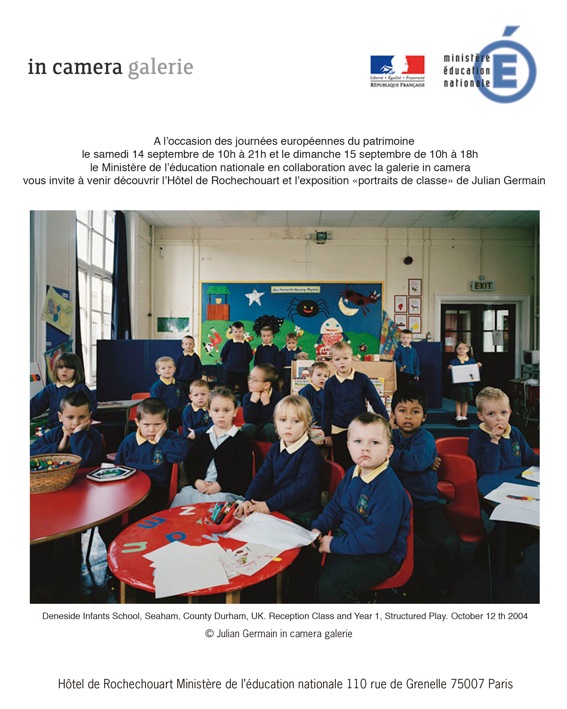
PORTRAITS DE CLASSE 

The Ministry of Education in Paris is opening it's doors to the general public this weekend, 14th and 15th September and is exhibiting a selection of Classroom Portraits throughout the building.

Ministry of Education
110, rue de Grenelle, Paris 
14 - 15 September

Wednesday, 6 February 2013

Classroom Portraits at In Camera Galerie, Paris


A selection of work from the Classroom Portraits series is being shown at In Camera Galerie, Paris, from February 14th (vernissage 6 - 9pm) until March 23rd.

21 rue Las Cases, 75007, Paris
Gallery opening hours, Tuesday - Saturday, 2 - 7pm, or by appointment.
www.incamera.fr    /   contact@incamera.fr    /    +33(0)1 47 05 51 77

Wednesday, 14 November 2012

News

Classroom Portraits Book Signing

Paris Photo, Grand Palais, Avenue du Général Eisenhower, Paris.
Stand D39 (In Camera Gallery), 6pm, November 15th

Paris Photo 2012


Roads to Wigan Pier

Impressions Gallery, Bradford, until 5th January, 2013
Russell Boyce, Huw Davies, Julian Germain, Graham Hall, John Kemp, Tim Smith 

Impressions Gallery 


"In the summer of 1984, taking as their starting point George Orwell’s seminal 1937 publication The Road to Wigan Pier, a sociological investigation into the bleak living conditions of the working class in Yorkshire and Lancashire, six newly graduated students of photography were commissioned by Impressions to record and document social aspects of the North of England. Each worked independently and each took a personal viewpoint. These non-judgemental, yet sometimes shocking, photographs show us a way of life that was in terminal decline. This picture of Orwellian dystopia acts as an elegy of the northern urban landscape and its people, on the brink of irrevocable social and cultural change. Today, in-post industrial Britain, we are perhaps inclined to forget the recent past as many of the symbols of poverty and neglect have been replaced by regeneration." 

                                        © Julian Germain, 1984     

Big Meetings 

Woodhorn Museum, Ashington, Northumberland, until December 23rd

Big Meetings is a new series of photographs and films by Julian Germain in response to the annual Durham Miners Gala, commissioned by Durham County Council.

Attended by up to 100,000 people, the Gala is one of the largest political gatherings in Europe. As well as photographing the main event: the parade, speeches and the banner blessings in the Cathedral, Germain has explored some of the deeper stories behind it.

He records the communities and landscapes of former pit villages such as Chopwell, Trimdon Grange and Ferryhill, showing the local residents as they prepare their banners for the Gala. He has visited band rooms, clubs and community centres to portray the brass bands in the places where they practice every week and he has also attended gatherings and meetings of some of the political or campaigning groups who use the Gala as a platform to promote their ideas.

The 2 synchronised video portraits feature a 77 year old man and a 9 year old boy performing the protest song and socialist anthem The Red Flag, encouraging us to consider the dramatic changes that have happened to industry, culture, society and politics during the last 3 generations.

The exhibition is about the significance of working class identity and cultural traditions and their ties to a set of political beliefs at a time when only fragments remain of the industries that framed them. While documenting both the spectacle and the spirit of the Gala, Germain is also implicitly asking questions about the nature of politics now, as capitalism appears to falter and socialist ideals are widely believed to have been marginalised by the rush to consumerism.

                                             © Julian Germain, 2012 / Stills from The Red Flag       


Sunday, 21 October 2012

Exhibition - The Beautiful Horizon


The Beautiful Horizon, the first UK exhibition of the work of the No Olho da Rua Collective, made up of approximately 75 young people living on the streets of Belo Horizonte, Brazil, Julian Germain, Patricia Azevedo and Murilo Godoy. The collective has been functioning on a sporadic basis since 1995.  The show is at Fabrica Gallery, Brighton, 6 October - 25 November. It features flyposters, newspapers, video portraits, flyers, exhibition prints and, most importantly, the first phase of the new project archive in the form of more than 125 boxed sets of enprints, enabling gallery visitors to explore the narratives in entire rolls of film. 

For more information and to download interview of Julian Germain, Patricia Azevedo and Murilo Godoy by Mark Sealey:  http://fabrica.org.uk/exhibitions/ 

For more information about the Brighton Photo Biennial: http://www.bpb.org.uk/2012/

Julian Germain Talk - Fabrica, Brighton. Monday 22nd October, 6.30 pm

Tuesday, 14 August 2012

No Olho da Rua 13/08/2012


Photo Albums

We've known Biui since 1995. In recent years he's been a bit crazy and scary. He's big and fast and very strong, in much better physical shape than most of the street kids of his age. He's always been around but hasn't wanted to make pictures for years and he hasn't wanted to be photographed either. But today he told us he had photos he wanted to show us and out of an old rucksack came two albums. They contain photographs spanning the entire project, from 1995 till last year, flyposters, newspapers, everything is there. We were astonished. It's so difficult for them to look after things. For these pictures to survive for so long, on the streets, is incredible.

He talked about a photo he doesn't have but which he clearly remembers. It's of him and Edna, his lover and the mother of his kids, who died of Aids a few years ago. They are kissing on a bus, on their way to the party we organised for the launch of the flyposter exhibition in 1997. We have to go back and look for this picture, try to find it for him.

He also asked us if he could have a camera to make some new pictures.

Licaõ's lost camera

We found Licaõ on Sunday. He has left Patricia, his lover of many years, at least for the time being. He says he needs a break. He is taking a lot of crack. Elisangela is with him, not in her house, but on the street. We gave him a camera but when when we went to collect it yesterday he explained he had finished the film but had a row with his crack dealer who threw the camera over a steep bank into some bushes. We went off to look for it. Seemed like an impossible task and it was quite a funny situation - we were like kids who'd lost their ball. Amazingly, after 10 minutes or so, there it was, Licaõ spied it nestling in the rubbish and scrub....be interesting to see the pictures...

Sunday, 12 August 2012

No Olho da Rua 12/08/2012

Looking for Licaõ

I am finally back in Belo Horizonte. it's some 18 months since I was last here. Patricia and Murilo keep in contact with the street kids (this could be a strange term for them as most are in their thirties now, but that's what they call themselves). Yesterday, we set out to look for them. We started at the soup kitchen they generally visit on a Saturday. It wasn't busy but we did see Reginaldo, Licaõs' uncle. He confirmed that most people are still around here and there but that Miguel has been in hospital since he was run over by a motorbike. He asks for a camera.
     Next we went to the shopping street in Gameleira where Sandro used to live. The last time we saw him he was in a terrible state but thankfully, there he was, sitting outside the same moderately smart ladies clothes shop, not exactly enhancing their window display. He's not a pretty sight, battered, bruised, fat lipped, bleeding gummed and his clothes are filthy. He can't use his left arm or hand at all and struggles to walk, but in the scheme of things he is quite organised, with a shopping trolley to wheel his stuff around. The people around him, the ladies in the clothes shop, the guys in the bar next door, obviously know Sandro well and they must look out for him, otherwise we can't imagine he could be there. He wants a camera and a pair of shorts. The camera we have and luckily we have one with autowind because with one hand he can't manually wind the film on.
    There are no kids under the Gameleira tree and there's obviously been a big clean up. No litter means no kids. A guy washing cars there says there haven't been kids there for a while. We drive on and soon see a group under some trees on a patch of land encircled by busy traffic. We park the car and look for a way to get across the roads. It's no wonder so many of them get hit, stoned on crack or thinner, weaving their way through this traffic. We find Preto, Silvana and Vinicius sitting on a sofa under a tree and numerous other boys and girls are there too. They have a couple of small tables, some broken office chairs, a tatty Brazilian flag flutters from a branch. They are relaxing and really pleased to see us and Patricia digs out some photographs to give them. Preto is better than before, much more calm. He is listening to the Brazil v Mexico Olympic football final on a tiny transistor radio. They are losing 1 - 0. Another boy is wearing a cool looking pink headphone radio but it doesn't work. Vinicius is also in better shape. The last time we saw him he was on crutches after being run over. Silvana is happy and pregnant and we leave them with three cameras. The others want to play as well and we agree to bring them cameras today.
    Next we go looking for Patricia and Licaõ. The last year has been traumatic for them. They had a baby last April and they were allocated an apartment from a government social programme. They had a cooker and a fridge, Patricia and Murilo got them an old TV and a double bed and other bits and pieces. It was an exciting moment, full of promise, but it didn't last. The baby got sick and tragically died and it wasn't long before they were back on the streets. Worse, they then lost their other two kids into the care system. First, we find a group that includes Celia, Buiu and Sueli, none of them photographers but we have known them for years. They are friendly but anxious to start smoking crack so we leave them to get on with it. Patricia is not far away, living in quite an organised place under a road bridge and she's upset a) because her leg got burned in a fire and b) Licaõ has disappeared and she is worried he might be with another girl. She gets in the car and we go looking for him. We drive around and then she takes us to a pleasant stretch of wasteland with trees and bushes and lots of pretty lilac flowers and a nice elevated view. There are quite a few street people here and there but not Licaõ and nobody has seen him. Eventually, Patricia asks us to take her to her mothers house. She packs two bags with her belongings and leaves the street. Her mother collapsed last week and is back from hospital, sick in bed, unable to walk at the moment. We leave her a few $R and Patricia takes a camera. We head for home.